
A surveyor’s guide to Worthing architecture: from Regency seafront to suburban semi
Worthing has grown up in layers, and you can walk through every one of them on its streets. A short walk from the pier inland will take you past Regency stucco, Victorian bay-fronted terraces, Edwardian villas, interwar semis and post-war estates – often within the same postcode. For homeowners and anyone thinking of moving here, that variety is part of the appeal. It also means no two properties survey quite the same way.
This guide takes a tour through the town’s housing stock by era, highlighting where to find each style, what makes it special and the issues that crop up most often during a survey. If you’re buying your first flat in central Worthing, considering a 1930s semi in Goring-by-Sea or tackling a Victorian project in Tarring, knowing what you’re looking at is half the battle.
How Worthing grew – the potted history
Worthing was a fishing hamlet for most of its life. It became a fashionable Regency resort almost overnight in 1798, when Princess Amelia, the youngest daughter of George III, was sent here to convalesce. The seafront was rebuilt in elegant cream stucco, and the railway’s arrival in 1845 brought a long Victorian boom of terraced streets that pushed the town inland and along the coast. The 20th century filled in the gaps with garden suburbs, interwar semis and seaside bungalows, and more recent decades have added flats, infill schemes and the regeneration happening around the seafront and town centre today.
Each of those waves left a distinct stock of homes – and a distinct set of things a surveyor expects to find.
Late Georgian and Regency: the seafront set-piece (c.1790–1840)
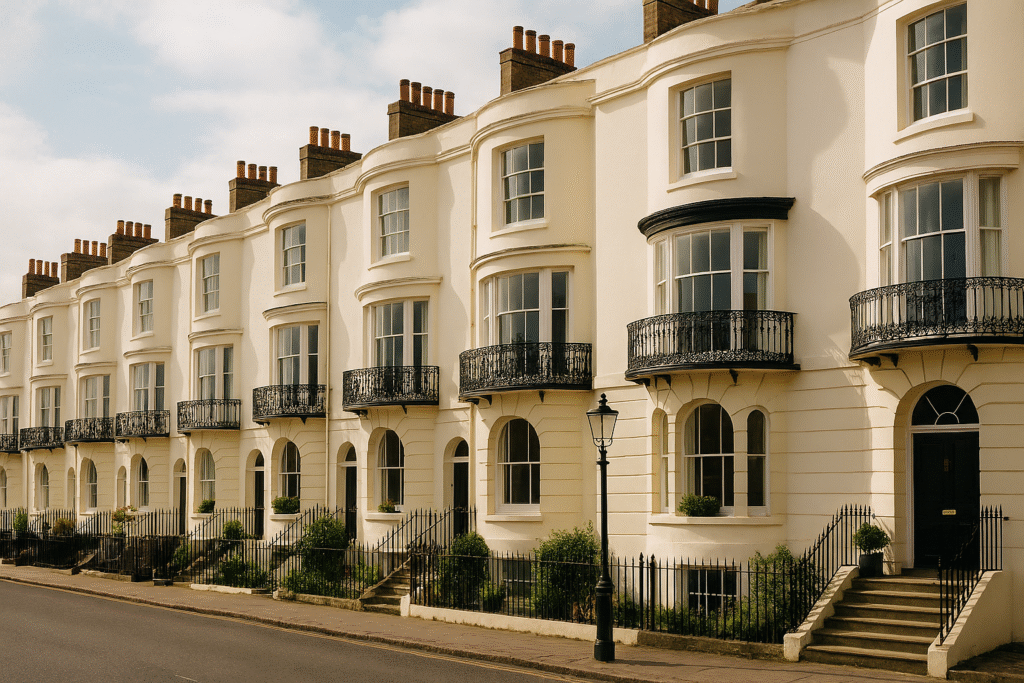
Worthing’s most photographed buildings sit along Marine Parade, The Steyne, Liverpool Terrace and Park Crescent. These are the bow-fronted, stucco-rendered, often four-storey townhouses that grew up when Worthing was reinventing itself as a resort. Park Crescent, designed by Amon Henry Wilds in 1829, is the showpiece, and Liverpool Terrace remains one of the most complete Regency streets in Sussex.
Most of these properties have been carved into flats over the years, which is fine in principle but a recurring source of issues in practice. What we typically look for:
- Render and stucco failure. The lime render that gives these buildings their cream uniformity moves with the building. Patches of modern cement render trap moisture and cause spalling – a very common finding.
- Sash windows in poor repair. Original timber boxes are often still in place but painted shut, with rotten sills and broken cords. Replacements with uPVC are usually disallowed inside the conservation area.
- Roof and parapet defects. Hidden valley gutters and parapet walls are the most common source of internal damp in these buildings.
- Lateral conversions and shared roofs. When a single house has been split into four or five flats, drainage, maintenance liabilities and lease arrangements need close inspection.
A property of this age and complexity is exactly the sort that benefits from a full Building Survey rather than a HomeBuyer Report – the level of detail simply matches the level of risk.
Victorian: the bay-fronted backbone of the town (c.1840–1900)
Once the railway arrived, Worthing spread outwards in long red-brick and yellow-stock terraces. You’ll find them across Heene, central Worthing, parts of Broadwater and along the streets running north from the seafront. These are the bay-fronted, two- or three-storey terraces that make up so much of the town’s rental and first-time-buyer market.
Common Victorian-era issues we look out for:
- Solid walls. Most are 9-inch solid brick with no cavity. They breathe well in their original state but suffer if sealed with modern impervious paints, plastic membranes or cement pointing.
- Rising damp – real and misdiagnosed. Many Victorian terraces have been injected with chemical damp-proof courses that haven’t worked, while the actual problem is raised external ground levels, blocked sub-floor vents, or failed render. We see this a lot.
- Slate roofs nearing the end of life. Original Welsh slates can last 100–150 years, but the nails fail first (“nail sickness”). Slipped slates are an early warning.
- Bay window lintels. Timber lintels above bays decay where gutters have leaked, leading to dropped or cracked masonry.
- Cellars and sub-floor voids. Worthing’s flat coastal plain means many sub-floors sit close to ground level. Poor ventilation here drives floor decay and damp readings on internal walls.
The Heene Conservation Area protects much of this stock, and Broadwater’s conservation area covers the historic village core. Owners should expect controls on windows, doors, render and roof materials.
Edwardian: The villa years (c.1900–1914)
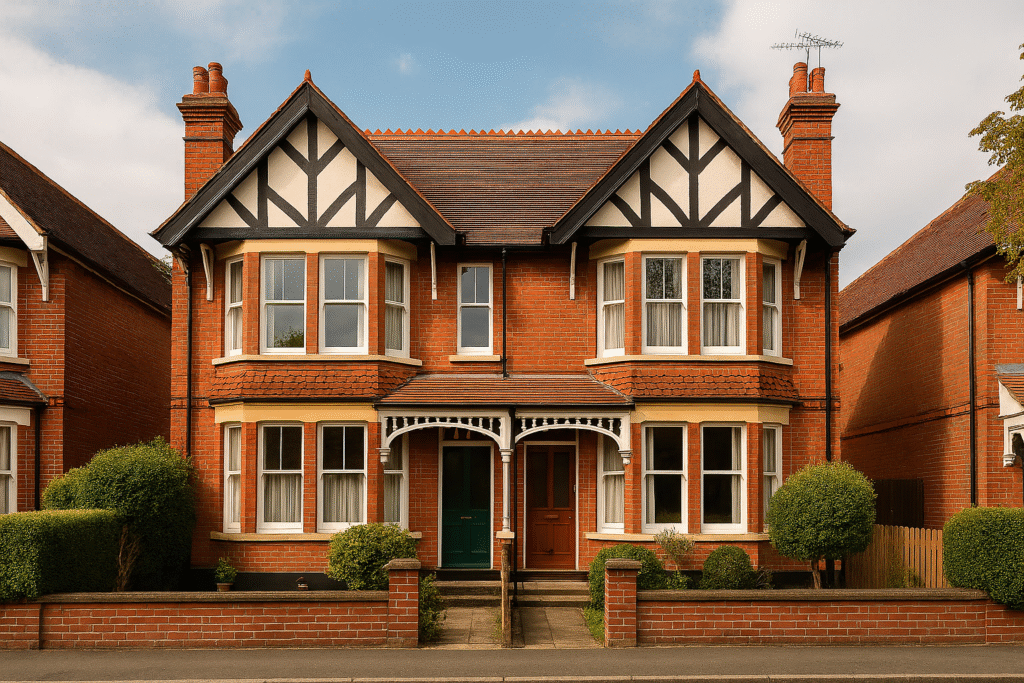
Worthing’s Edwardian housing tends to be more generously proportioned than its Victorian terraces. Look at the streets around the Heene/Poets area (Browning Road, Chaucer Road, Shakespeare Road and Longfellow Road) as well as Shelley Road, Wykeham Road, parts of Broadwater and the southern fringe of Tarring. Bay windows are bigger, gardens are deeper, and decorative timber, mock-Tudor gables and red ridge tiles start to appear.
Surveys typically flag:
- Decorative timber decay. The pretty barge-boards and porch posts that distinguish Edwardian villas are often the first thing to rot.
- Original tiled paths and porches. Charming but easily damaged by clumsy repairs – worth checking before assuming they’re intact.
- Early cavity walls. Some Edwardian properties have a narrow cavity, which complicates insulation decisions; cavity fill in coastal locations is a known risk because driving rain can bridge wet insulation across to the inner leaf.
Interwar: 1920s and 30s suburbia (c.1918–1939)
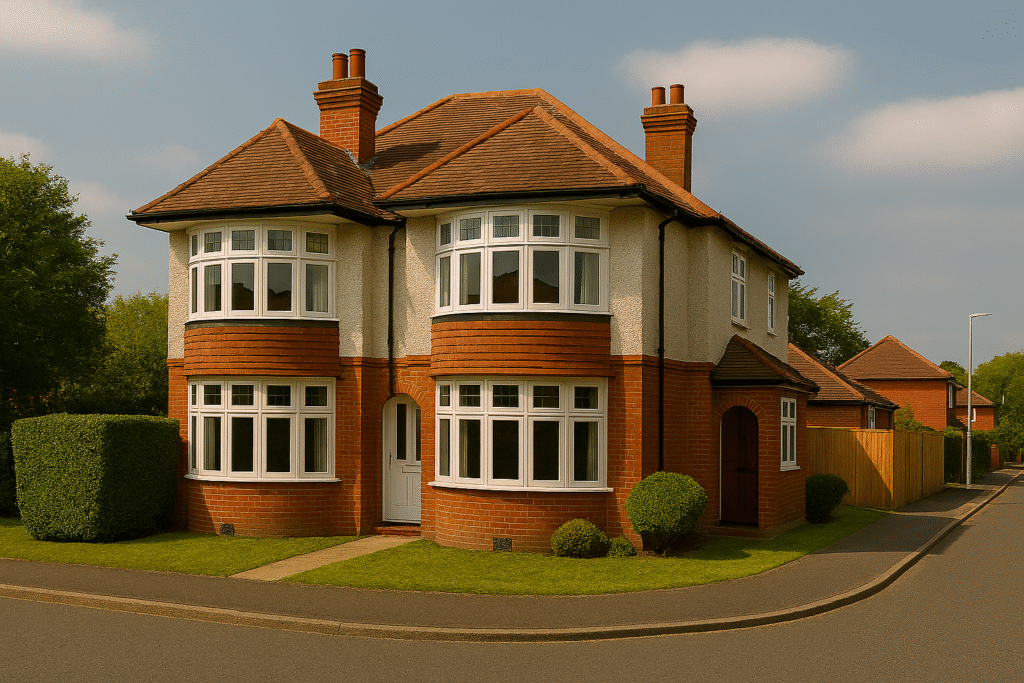
This is the era that defines Goring-by-Sea, much of Durrington, large parts of East Worthing and Findon Valley. Bay-fronted semis with leaded lights, pebbledash, mock-Tudor timbering and red-tiled roofs – the classic between-the-wars suburban look. The stock is well-built on the whole, and these are some of the most popular family homes in the town.
Things we routinely pick up:
- Pebbledash issues. Cracking, hollow-sounding sections and rust staining from corroded metalwork beneath are common. Patch repairs rarely match.
- Original windows and steel-framed Crittall units. Often handsome but cold, and the steel frames rust at the sills. Replacement is allowed in most areas but check the local conservation status first.
- Asbestos. Eaves soffits, Artex ceilings, flue pipes and even roof tiles in some interwar housing can contain asbestos. Disturbing them needs care.
- Garage and rear extensions. Decades of additions, some with proper foundations, some without. Uneven settling between the original house and a 1970s rear extension is a frequent finding.
- Subsidence on clay. Pockets of shrinkable clay exist around Worthing, particularly in the lower-lying suburbs. Cracks near corners, doors that stick seasonally and trees within a tree’s height of the building all warrant a closer look.
Post-war: 1950s–1970s estates and seaside bungalows
Maybridge, parts of Northbrook, much of High Salvington and the bungalow estates spreading west toward Ferring belong to this era. Construction quality varies enormously. Some are solidly built traditional cavity-wall homes; others were experimental “non-standard construction” types using concrete panels, steel frames or no-fines concrete. It can be tricky to secure a mortgage for the latter type of property.
Look out for:
- Concrete or system-built construction. Identify it early – it changes everything from insurance to lending.
- Flat-roof extensions and dormers. Felt roofs from this period are well past their design life if not replaced.
- Single-skin garages and outbuildings. Frequently converted into habitable space without proper insulation, damp-proofing or building regulation sign-off.
- Aluminium and early uPVC windows. Often beyond economic repair and a likely upgrade cost to factor in.
Modern flats, conversions and new-build (1990s onwards)
Worthing’s seafront and town centre have seen significant new-build in the last two decades, with several large schemes around Bayside, the former Aquarena site and Teville Gate either complete or in progress. Add to that the continuing wave of larger Victorian and Edwardian houses being converted into flats, and a sizeable portion of the local market is now leasehold.
Modern issues are different but no less important:
- Cladding, balconies and EWS1 forms. Post-Grenfell, lenders may require evidence on external wall systems, particularly on blocks above 11 metres.
- Lease length, ground rent and service charges. Short leases or escalating ground rents can make a flat hard to sell on.
- Conversion quality. Sound transmission, fire compartmentation, drainage runs and means of escape are often inadequately addressed in informal conversions of older houses.
- New-build snagging. Defects in the first two years are normally covered by NHBC or a similar warranty – worth identifying before that window closes.
Issues that affect every era: coastal Sussex realities
Some problems don’t care what year your house was built. Worthing’s position – a flat coastal strip with the South Downs immediately behind it – produces a recognisable set of recurring themes:
- Salt-laden air. Accelerates rust on iron and steel, attacks soft mortars and degrades sealants and renders faster than inland. Wrought-iron railings, balconies and steel lintels need regular maintenance.
- Wind-driven rain. Worthing’s seafront properties get the brunt of the prevailing south-westerlies. South-facing elevations weather faster and need more frequent decoration.
- Surface water flooding. Several pockets of central and East Worthing are flagged as medium or high risk on the Environment Agency’s flood map. Coastal flood risk is generally low thanks to the seawall, but worth checking.
- Chalk and clay geology. Most of Worthing sits on the coastal plain over chalk, but pockets of London Clay and made-up ground produce localised subsidence and soakaway problems.
- Japanese knotweed. Reported across the south coast. Always check the rear and side boundaries, particularly on terraced properties backing on to disused land or railway embankments.
Conservation areas and listed buildings: what changes
Worthing has several designated conservation areas, including Heene, Broadwater, Christchurch, Liverpool Terrace and Park Crescent, plus a number of listed buildings. If your prospective home falls within one, you should expect:
- Article 4 directions in some areas, removing standard permitted development rights for things like front-elevation windows, doors and rendering.
- Tighter consent requirements for replacement windows, satellite dishes, render, roof materials and external paint colour.
- Protected trees – worth a tree preservation order check before assuming a problem tree can be removed.
A pre-purchase survey can confirm what unauthorised work has been carried out and what the implications are. For listed buildings in particular, retrospective listed building consent is a real risk if previous owners replaced original features without permission.
How a Worthing surveyor helps
When it comes to a property survey, there is no substitute for someone who knows what to expect from that location. We provide RICS-accredited HomeBuyer Surveys, Level 3 Full Building Surveys and damp surveys across Worthing and the surrounding villages – from Ferring and Goring, Broadwater and Findon to High Salvington and Sompting.
If you’re unsure which survey is right for the property you’re buying, get in touch – our Worthing surveyors are ready to help
Worthing’s architecture is one of the things that makes it a lovely place to live. Buying into it well is mostly a matter of knowing what to look for – and using the services of someone who already does.