
Everything you need to know about party walls
If you’re planning building work on your home – a loft conversion, rear extension, basement, or even removing a chimney breast – you may well have come across the term “party wall.” It can feel like a mysterious piece of legal jargon, something you suspect matters but you’re not quite sure why.
You’re not alone. Party wall issues are one of the most commonly misunderstood aspects of home renovation in the UK – and also one of the most common causes of project delays.
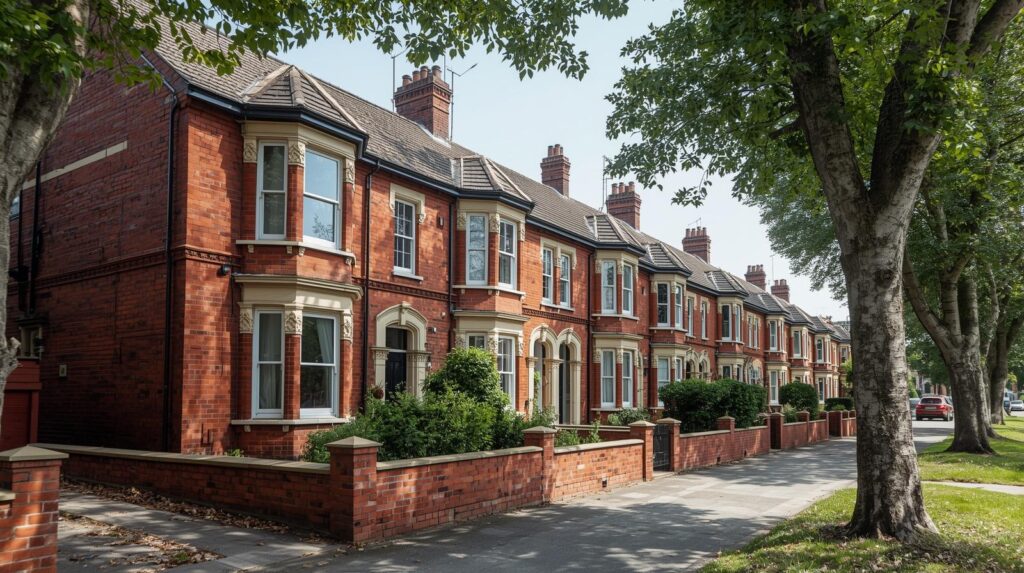
This guide is designed to answer every question you’re likely to have about party walls, the Party Wall etc. Act 1996, and what the process actually involves. You could be a building owner planning work, or a neighbour who’s just received a party wall notice and isn’t sure what it means; this guide is for you.
We’ve written it in a FAQ format so you can jump straight to what you need – or read it cover to cover if you’d like to understand the whole picture.
- Part 1: The basics
- Part 2: When does the Act apply?
- Part 3: Party wall notices
- Part 4: Party wall surveyors
- Part 5: The Schedule of Condition
- Part 6: The Party Wall Award
- Part 7: Costs
- Part 8: Common mistakes – and how to avoid them
- Part 9: What if things go wrong?
- Part 10: Special situations
- Part 11: Party walls in Sussex – a local perspective
Part 1: The basics
Q: What is a party wall?
A party wall is a wall shared between two properties, typically sitting on or at the boundary line. The most common examples are the dividing wall between two semi-detached houses, or the wall that a terraced house shares with the properties on either side.
The term “party” in this context comes from an older legal usage meaning “shared between two parties.” Both property owners typically have rights and responsibilities relating to that wall.
Q: What is a “party structure”?
The Party Wall etc. Act 1996 covers not just walls but also other shared structures. A “party structure” includes floors between flats (where one owner’s ceiling is another’s floor), partition walls in converted buildings and “party fence walls” – boundary walls that sit directly on the boundary line and are used by both properties.
It’s worth noting that a garden fence or hedge is not a party fence wall in legal terms. This term applies specifically to masonry walls built across or at the boundary.
Q: What is the Party Wall etc. Act 1996?
The Party Wall etc. Act 1996 is a piece of legislation that came into force in England and Wales on 1 July 1997. Before then, party wall matters were governed by a patchwork of common law, some of it contradictory and some of it regional – which made things unnecessarily complicated for both homeowners and professionals.
The Act was developed with input from several professional bodies, including the Royal Institution of Chartered Surveyors (RICS), to bring the law together into one coherent framework. At its heart, it does three things: it gives building owners the right to carry out certain types of work that affect shared structures or boundaries; it gives neighbouring owners’ rights to protection and notice; and it provides a mechanism for resolving disputes, administered by surveyors with statutory powers to adjudicate.
In effect, it gave Chartered Surveyors legal rights for certain property matters.
Q: Is a party wall the same as a boundary wall?
Not necessarily. A boundary wall runs along the boundary between two properties, but it may belong entirely to one owner. A party wall, on the other hand, sits on or straddles the boundary line and is shared.
The Act also covers work carried out near a boundary, even if no shared wall is involved – for example, excavating foundations within certain distances of a neighbouring property’s structure. So the Act’s scope is broader than the term “party wall” might suggest.
Q: Who owns a party wall?
In most cases, each owner owns the half of the party wall that sits on their side of the boundary line. Both owners have rights over the entire wall for certain purposes – for example, the right to carry out repairs to the whole structure. The Act sets out these rights clearly, and a party wall surveyor can clarify the position as it applies to your specific case.
Part 2: When does the act apply?
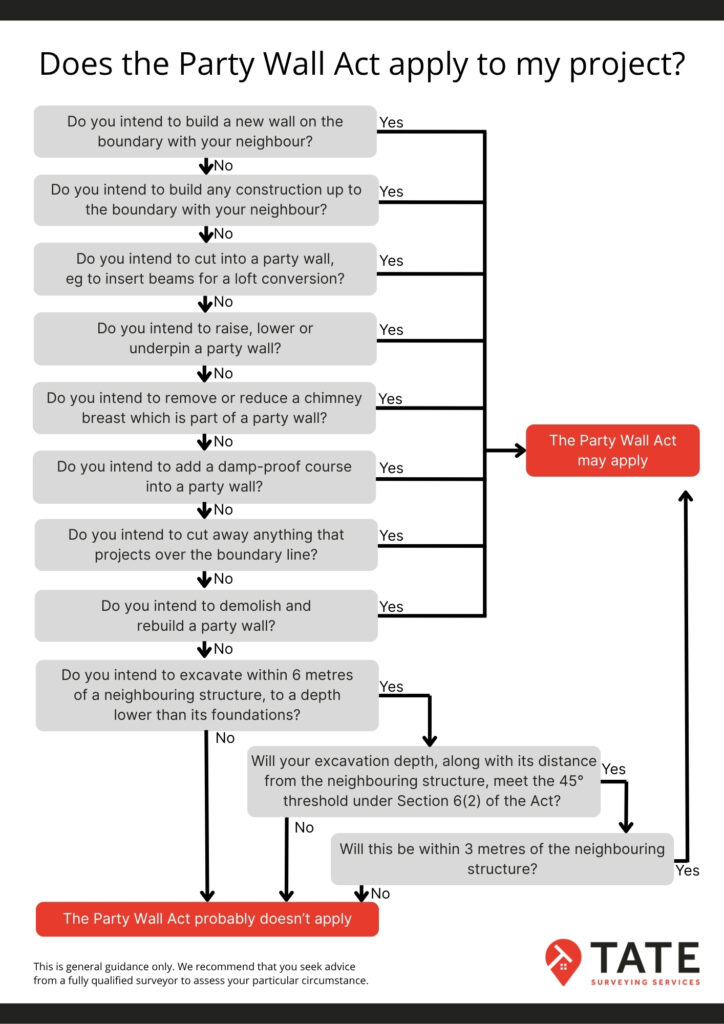
Q: Does the Party Wall Act apply to my project?
This is the first question to ask before any building work starts. The Act applies to a surprisingly wide range of work, and many homeowners only find out it applies when their architect or contractor mentions it late in the planning process – by which point the intended start date may be close.
The Act covers three broad categories of work:
Section 1: New walls on or across the boundary line
If you intend to build a new wall on the boundary line between your property and your neighbour’s, or to build up to the boundary, this falls under Section 1 of the Act. This is common with side extensions.
Section 2: Works to an existing party wall or structure
This is the most commonly triggered section and covers a wide range of works, including:
- Cutting into a party wall to insert beams for a loft conversion.
- Raising or lowering a party wall.
- Underpinning a party wall.
- Removing or reducing a chimney breast that forms part of a party wall.
- Inserting a damp-proof course.
- Cutting away projections over the boundary line.
- Demolishing and rebuilding a party wall
Section 6: Excavation near a neighbouring structure
If you plan to excavate within 3 metres of a neighbouring structure to a depth lower than its foundations, or within 6 metres if the depth of the excavation could affect the ground beneath the neighbouring foundations (assessed using a 45-degree angle from the base of those foundations), Section 6 of the Act applies. Basement projects and deep extensions frequently trigger this section.
Q: Does the Act apply to commercial and leasehold properties?
Yes. The Act applies to all property types – residential, commercial, and industrial – wherever there is a shared structure or boundary. Leasehold properties also fall within the Act’s scope, though the question of who is responsible for serving and receiving notices is more complex. The freeholder, the leaseholder or both may be involved depending on the nature of the works and the terms of the lease.
Q: What if the work is minor – does the Act still apply?
The Act is about the legal process, not the scale of the work. Even minor structural work – such as cutting into a party wall to fit a new beam for a relatively straightforward loft conversion – triggers the Act and requires notice to be served. The size or value of the project is not a determining factor.
However, routine maintenance and decoration on your own side of the wall (filling cracks, repainting, fitting shelves, for example) does not trigger the Act.
Part 3: Party wall notices
Q: What is a party wall notice?
A party wall notice is a formal written notification to your neighbour that you intend to carry out work that falls within the scope of the Party Wall etc. Act 1996. Serving it is a legal requirement. It’s not a courtesy and it’s not optional.
The notice sets out who is proposing the work, what the work involves and when it is planned to begin. It starts the legal clock running: your neighbour has a defined period to respond, and that response determines what happens next.
Q: When do I need to serve notice, and how far in advance?
You must serve notice before any work begins – but the Act specifies minimum notice periods depending on the type of work:
- Section 2 (works to an existing party wall): at least 2 months’ notice
- Section 6 (excavation): at least 1 months’ notice
- Section 1 (new wall on the boundary): at least 1 month’s notice
In practice, we always recommend starting the process 2–3 months before your intended build start date – and earlier if your project involves excavation or multiple neighbouring properties. The notice period is only the beginning; there is further time required for neighbour responses, surveyor appointments, and preparation of the Award.
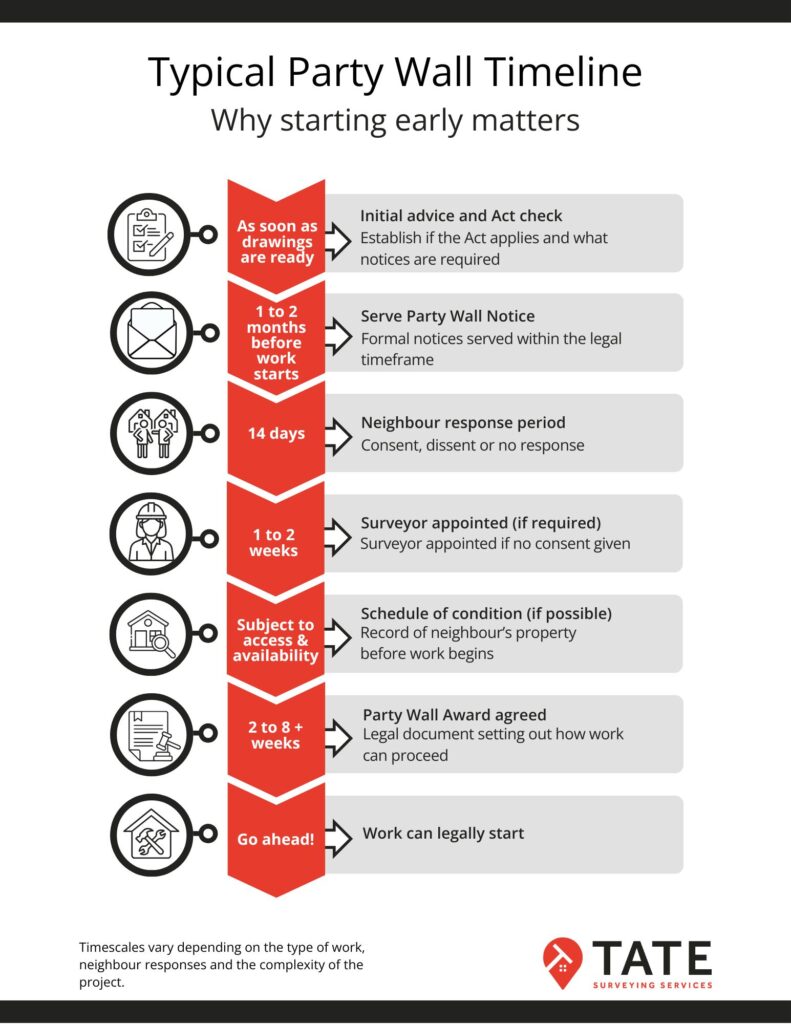
Read more about potential delays in the party wall process.
Q: What must a party wall notice include?
A valid notice must include:
- Your full name and address.
- The address of the property where the work will take place
- A clear description of the proposed works
- The planned start date
- Reference to the relevant section of the Party Wall etc. Act 1996
For Section 2 works, drawings showing the proposed works should accompany the notice wherever possible. Notices that are incomplete or ambiguous can be challenged, which means you may have to reissue them – and the clock starts again from the beginning.
Q: Can I serve a party wall notice myself?
Technically, yes – there is no legal requirement for a professional to serve the notice on your behalf. However, a notice that turns out to be invalid wastes time and money and the consequences can be significant if it delays your build.
Common problems with DIY notices include using out-of-date templates, describing the works too vaguely, missing the correct statutory references, or serving the notice on the wrong person (for example, a tenant rather than the freeholder). We regularly see projects set back by weeks because of an invalid notice served too late.
At Tate Surveying Services, we prepare professionally drafted party wall notices as part of our service, giving you confidence that the process starts correctly from day one.
Q: What are the different types of party wall notice?
There are three notices that may need to be served, corresponding to the three sections of the Act:
- Party Structure Notice (Section 2): for works to an existing party wall or structure.
- Line of Junction Notice (Section 1): for building a new wall at or astride the boundary.
- Notice of Adjacent Excavation (Section 6): for excavations near neighbouring foundations.
Sometimes a project triggers more than one type of notice – for example, a basement project that also involves cutting into the party wall would require both a Party Structure Notice and a Notice of Adjacent Excavation.
Q: What happens once I’ve served notice?
Your neighbour has 14 days to respond in writing. They have three options:
- Consent: They agree to the works in writing. Work can proceed (though a Schedule of Condition is still advisable).
- Dissent and appoint an agreed surveyor: They object, and both parties agree to appoint a single, neutral surveyor to manage the process.
- Dissent and appoint their own surveyor: They appoint their own surveyor, and you appoint yours.
Q: What if my neighbour doesn’t respond to the notice?
If your neighbour doesn’t respond within 14 days, the Act automatically treats their silence as dissent – a dispute is deemed to have arisen. Surveyors must then be appointed on both sides. This is not an unusual situation; people go on holiday, forget, or simply feel uncertain about what to do.
The key thing to know is that a non-response does not block your project. The legal process continues, and a Party Wall Award can be made even if your neighbour is entirely disengaged.
Q: What if my notice is invalid?
An invalid notice – one that is missing information, describes the works incorrectly, or has been served on the wrong person – must be reissued. This restarts the notice period in full. If your build is already imminent, this can cause significant delays. It’s one of the most common and easily avoidable causes of project hold-ups that we see.
Part 4: Party wall surveyors
Q: What does a party wall surveyor actually do?
This is one of the most important points to understand – and one that causes considerable confusion. A party wall surveyor is not primarily a structural inspector. Their role is legal and administrative: they manage the party wall process, draft the notices, assess the proposed works, prepare the Schedule of Condition, and ultimately produce the Party Wall Award.
When a party wall surveyor is appointed under the Act, they do not act for either party. They act impartially, in accordance with their statutory duty, to find an equitable solution that protects the legitimate interests of both the building owner and the adjoining owner.
A good party wall surveyor uses their construction knowledge and experience to find practical solutions – for example, suggesting a different scaffolding design that avoids damaging a neighbour’s mature garden, or setting out working hours that minimise disruption to a home-based business next door.
Q: My neighbour wants a ‘party wall survey’. Do they mean a structural inspection?
Almost certainly not – though the terminology is confusing. When people refer to a “party wall survey” or a “party wall surveyor,” they are usually referring to the legal role under the Act, not a physical inspection of the wall’s structure.
There is rarely any need to physically inspect a wall to determine whether it is structurally sound before serving a party wall notice. What matters is complying with the correct legal process. If a structural issue is suspected, that is a separate matter – a building survey or structural engineer’s assessment would be the appropriate next step.
Q: Who can act as a party wall surveyor?
This is an area where homeowners should tread carefully. Under the Act, almost anyone can technically act as a party wall surveyor – there is no statutory requirement for formal qualifications. However, this does not mean all party wall surveyors are equal.
The Faculty of Party Wall Surveyors (FPWS) was established specifically to bring standards and professionalism to the field. Members – such as Tate Surveying Services, who carry the designation MFPWS – are trained specifically in party wall law and procedure and are bound by a code of conduct.
Using an unqualified party wall “surveyor” can result in errors that are expensive to correct, or Awards that don’t adequately protect your interests. We strongly recommend using a surveyor who is a member of the FPWS or who is RICS regulated – or ideally both.
Q: What is an “agreed surveyor”?
When a dispute arises (or is deemed to have arisen due to non-response), both the building owner and the adjoining owner can agree to appoint a single, shared surveyor to manage the process. This is called an “agreed surveyor.”
The agreed surveyor acts neutrally for both parties. This approach is generally faster and less expensive than both parties appointing separate surveyors and works well when the works are relatively straightforward and the relationship between neighbours is cooperative.
Q: What happens if both neighbours appoint separate surveyors?
When both parties have their own surveyor, those two surveyors work together to prepare the Party Wall Award. At the outset, they must also select a “third surveyor” – an independent figure who is only called upon if the two appointed surveyors cannot agree on a matter, or if one of the owners wishes to refer a specific issue for independent determination.
The third surveyor’s role is effectively that of an appeals judge: they sit in reserve, and their involvement is relatively unusual. But their appointment at the outset is a statutory requirement.
Part 5: The Schedule of Condition
Q: What is a Schedule of Condition?
A Schedule of Condition is a detailed, photographic record of the neighbouring property’s condition before building work begins. It documents the state of the walls, ceilings, floors and other features that could potentially be affected by the planned works.
It serves a vital dual purpose: it protects the adjoining owner by creating an evidence base if damage is later claimed to have been caused by the works, and it protects the building owner from unfounded claims that pre-existing defects were caused by their project.
Q: Is a Schedule of Condition mandatory?
It is not strictly a legal requirement under the Act, but it is strongly advisable and is considered best practice in the industry. Most experienced party wall surveyors will recommend one as a matter of course.
Skipping a Schedule of Condition is a risk for both parties. Without a baseline record, any damage dispute becomes a “your word against mine” situation, which benefits no one and can be costly to resolve.
Q: What if my neighbour refuses access for a Schedule of Condition?
A neighbour is entitled to refuse access for a Schedule of Condition – that is their right. If they do, the party wall process continues regardless. The Award can be prepared and agreed without a pre-works condition record being completed.
The practical consequence of refusing is that the neighbour weakens their own position if they later try to claim that damage was caused by the works. Without a baseline record of the property’s condition beforehand, any such claim becomes much harder to substantiate – so the risk of refusing access sits with them, not with the building owner.
A good party wall surveyor will always make every effort to achieve access, explaining clearly what the visit involves and why it is in the neighbour’s own interest to allow it.
Part 6: The Party Wall Award
Q: What is a Party Wall Award?
The Party Wall Award (sometimes called an “award” or a “determination”) is the legal document that formally resolves the dispute and permits the building works to proceed. It is made by the appointed surveyor or surveyors and is binding on both parties.
Think of it as the green light for your project – but one that comes with a clear set of conditions and protections built in.
Q: What does a Party Wall Award contain?
A typical Award will set out:
- Confirmation of the building owner’s right to carry out the notifiable works
- A detailed description of the works permitted
- The method and sequence of works
- Agreed working hours for particularly noisy or disruptive activities
- Access arrangements for the surveyor and contractors
- Protection measures to be put in place
- The framework for dealing with any damage caused
- The costs of the surveyors involved (usually paid by the building owner)
Work cannot legally begin until the Award is signed. This is one of the most common causes of project delays we see: building owners set a start date and pay contractor deposits before the Award is finalised, only to find that outstanding drawings, engineering changes or surveyor queries push the date back.
Q: Can a Party Wall Award be appealed?
Yes. Either party has the right to appeal a Party Wall Award to the County Court within 14 days of receiving it. However, appeals are relatively uncommon and are usually only pursued if there is a genuine legal argument that the Award is flawed, unreasonable or outside the surveyors’ jurisdiction.
The appeal process is separate from the party wall procedure itself and is a matter for solicitors rather than surveyors. If you believe an Award is unfair, the best first step is to raise your concerns with the surveyor who made it.
Part 7: Costs
Q: Who pays for the party wall surveyor?
In the vast majority of cases, the building owner – the person carrying out the work – pays the surveyors’ fees. This includes both their own surveyor and, where the neighbour has appointed a separate surveyor, the reasonable fees of the adjoining owner’s surveyor too.
This is an important point for adjoining owners (neighbours): in most cases, you are entitled to appoint a party wall surveyor and have your costs covered by the person doing the work. You don’t need to pay out of pocket to protect your interests – unless certain circumstances arise, such as the adjoining owner being considered to act unreasonably, causing delays and running up surveyors’ costs.
Q: How much does a party wall surveyor cost?
Costs vary depending on the complexity of the project, the location, and how many properties are affected. As a general guide in 2026:
- Simple projects with one neighbour (agreed surveyor): approximately £700–£1,500
- More complex projects or two separate surveyors: approximately £1,800–£5,000+
- Basement or complex excavation projects involving multiple neighbours: costs can exceed £6,000
A single surveyor acting for both parties will tend to charge a bit more for their increased involvement but it’s usually less than the cost of two surveyors.
At Tate Surveying Services, we’re transparent about our fees from the outset and will give you a clear picture of likely costs before you commit. If you’d like a quote, please get in touch.
Part 8: Common mistakes – and how to avoid them
After years of helping homeowners across Sussex navigate the party wall process, we’ve seen the same mistakes come up again and again. Here are the most common – and how to sidestep them.
Mistake 1: Starting the process too late
The party wall process has mandatory timescales that cannot be shortened, even if everyone involved is cooperative and keen to move quickly. Notices must be served weeks or months before work begins, neighbours have time to respond, and the Award must be completed before a single tool is picked up. If you start the process late, your project start date moves with it.
The fix: Begin the party wall process at least 2–3 months before your planned build start. Ideally, run it in parallel with your planning application rather than waiting for permission to be granted first.
Mistake 2: Assuming a friendly neighbour means no delays
We’ve seen projects delayed in some of the friendliest streets in Brighton and Hove, Haywards Heath, and across Sussex. A cooperative neighbour is wonderful – but even consenting neighbours sometimes take time to reply formally, want to ask questions, or simply go on holiday at an inconvenient moment. The legal clock doesn’t stop for good relationships.
The fix: Speak to your neighbour early and informally about the works, but don’t rely on that conversation as a substitute for the formal notice process.
Mistake 3: Serving an invalid notice
Downloaded templates and informal letters often fall short of what the Act requires. An invalid notice has to be reissued, and the clock starts again. In a worst-case scenario, this can push a project back by more than a month.
The fix: Have your notices professionally drafted. The cost is small relative to the delay and disruption that an invalid notice can cause.
Mistake 4: Setting a start date before the Award is signed
Booking contractors and paying deposits before the Party Wall Award is finalised is one of the most stressful and costly mistakes we see. If the Award is delayed – due to missing drawings, engineering queries, or surveyor disagreements – you could be paying for contractors who have nothing to start on.
The fix: Do not commit to a fixed contractor start date or pay large deposits until the Award is in place. A good party wall surveyor will keep you informed of progress and flag any likely delays early.
Mistake 5: Confusing a party wall survey with a structural survey
Many homeowners (and, sometimes, their contractors) start by searching for someone to “survey the wall.” There is rarely any need for a physical structural inspection before the party wall process. The party wall surveyor’s role is legal and administrative, not diagnostic.
The fix: If you have concerns about the structural condition of a shared wall, a building surveyor can assess it separately. But don’t let this confusion delay you from starting the party wall notice process.
Part 9: What if things go wrong?
Q: What if my neighbour refuses to consent to the works?
Refusal to consent is not the same as blocking the works. Under the Act, your neighbour’s refusal (or non-response) simply means that a dispute is deemed to have arisen and surveyors must be appointed. The process continues, the Award is made, and the works can proceed lawfully once the Award is in place.
A neighbour cannot use the party wall process to veto building works that are lawful and properly notified. What they can do is ensure, through the Award, that those works are carried out safely and with proper protections in place.
Q: What if my neighbour has already started work without serving notice?
If your neighbour is carrying out work that you believe falls under the Party Wall Act without having served notice on you, you have a couple of options. You can ask them to stop and serve proper notice or you can apply to the court for an injunction.
This is a stressful situation, and the right course of action will depend on the specifics. We’d encourage you to contact us for advice as early as possible – acting quickly gives you the most options.
Q: What if the works damage my property?
If you believe damage has been caused to your property by your neighbour’s building works, the party wall framework exists precisely to help resolve this. The Schedule of Condition provides the baseline – if damage exists that wasn’t recorded before the works, there is a clear evidential basis for a claim.
Claims for damage are handled through the party wall surveyors in the first instance. If the surveyors cannot agree, the third surveyor can be called in to make a determination. Court proceedings are a last resort, and in our experience are rarely necessary.
Part 10: Special situations
Party walls in leasehold properties and flats
If you own a leasehold flat and want to carry out notifiable work, the party wall process becomes more complex. You will typically need to establish whether the works require the freeholder’s consent under your lease, and whether the freeholder or the leaseholder is the correct party to serve and receive notices under the Act.
Converted Victorian terraces – so common across Brighton, Hove, and the wider East Sussex coast – often have multiple flats with shared floors, ceilings, and walls, all potentially triggering the Act. Problems can creep in here – you may need to serve notice on every leaseholder and freeholder unless they agree that the freeholder alone can represent them. Potentially you can have multiple surveyors involved for multiple parties all wanting to be paid! Getting the paperwork right from the outset is essential.
Party walls and listed buildings
If your property or the adjoining property is listed, additional considerations apply. Listed building consent may be required for works that affect the character of the building, and your party wall surveyor will need to take this into account when drafting the Award. Sussex has a significant number of listed buildings – particularly in the South Downs villages, the historic centres of Lewes and Arundel, and across the Regency and Victorian terraces of Brighton and Hove. We have experience working with listed properties across the region.
Party walls and new-build developments
New builds present their own party wall challenges, particularly where a developer is building adjacent to existing properties. Multiple neighbours may be affected, multiple notices may need to be served, and the scale of the works can be significant. If you are a developer or a homeowner affected by a large-scale adjacent development, specialist advice is important from the outset.
Part 11: Party walls in Sussex – a local perspective
Sussex is a fantastic place to own property, but it does present some specific party wall challenges. The county’s housing stock is dominated by Victorian and Edwardian terraces – in Brighton, Hove, Worthing, Eastbourne, and Hastings – which typically means tightly built party walls, mature gardens and neighbours in close proximity.
Loft conversions are one of the most popular home improvements in the region, given the relative cost of moving and the demand for extra space. Streets across Hove, Preston Park, Seven Dials and Fiveways see loft conversions happening on a near-constant basis. Almost every single one requires party wall notices to be served – and quite often to two neighbours at once.
Rear extensions are equally popular, particularly in the terraces of Kemp Town, Portslade and Shoreham-by-Sea. And the trend for basement conversions, while more common in London, is increasingly making its way to Brighton’s Regency townhouses and larger Victorian properties.
We’re based in Hove and work across the whole of Sussex and beyond. We understand the local housing stock, we know the types of works that commonly trigger the Act in this area, and we have experience handling party wall matters for properties ranging from two-bedroom seaside terraces to large, detached farmhouses on the South Downs.
Ready to get started? Talk to Tate.
Whether you’re a building owner planning a loft conversion, extension or basement project, or a neighbour who has just received a party wall notice and wants to understand your rights, Tate Surveying Services can help.
We handle every aspect of the party wall process – from preparing and serving notices to producing Schedules of Condition and Party Wall Awards. We’re fast, clear and straightforward, and we’ll guide you through the process without jargon.
As RICS regulated surveyors and members of the Faculty of Party Wall Surveyors, you can trust that the job will be done properly – and that your project won’t be held up by avoidable delays.
Contact Us
Tate Surveying Services,
Freedom Works, Unit 7 Hove Business Centre, Fonthill Road, Hove, BN3 6HA
"*" indicates required fields