
Roof defects: what they can mean and how much they could cost
How often do you think about your roof? Like most people, probably only when something’s gone wrong. By then, it’s often more costly to put right than you might expect. We see the full range of properties and their roof types across Sussex – Victorian and Edwardian terraces in Brighton and Hove, weatherboarded cottages and slate roofs in Lewes, characterful and aged rooftops in Hastings Old Town as well as everything else from 1930s semis to newer builds with flat-roofed extensions.
If you see a crack or dip in your roof, it’s easy to assume something serious is going on underneath. But don’t instantly plump for the worst-case scenario. As our lead surveyor, Marc Tate points out, the vast majority of roofs in Sussex are pitched and finished in tile or slate, a naturally flexible form of construction. That means a tiled roof can move slightly with the building without cracking, which means roof cracks are fairly uncommon, even when there’s ground movement elsewhere in the property.
Unfortunately, that doesn’t mean roofs are trouble-free. Slipped tiles, failed flashing, sagging timbers and leaks are some of the most common issues we see and, if left unaddressed, can lead to some hefty repair bills. This guide looks at seven of the roof defects we see most often, what could cause them, how to spot the warning signs and where a professional roof survey really adds value – plus answers to some of our most frequently asked questions.
Missing, slipped and cracked roof tiles
What it means
Individual roof tiles or slates have come loose, cracked or slipped out of position, or fallen away from the roof entirely.
What causes it
Tiles age and weather over time, and the nails or battens holding them in place can fail well before the tiles themselves look obviously worn – sometimes called “nail sickness”. Wind is one of the biggest culprits: strong gusts can lift and dislodge tiles, especially where nearby trees, scaffolding or previous repairs have already loosened them. Fallen branches and careless ladder placement during other maintenance work can also crack or displace tiles.
Sussex has had a recent reminder of just how sudden this kind of damage can be. In December 2025, a tornado tore through Seaford, ripping garage roofs and doors clean off in Victor Close and Princess Drive. It’s an extreme (and rare) example – most tile damage happens far more gradually, over successive winters – but it shows how quickly a roof covering can fail under the right conditions.
How to spot it
Look up from the garden or street (binoculars help): gaps in the tile pattern, tiles that look a different colour or angle, and tile fragments in the gutters or on the ground are all warning signs. Inside, watch for damp patches or daylight visible through the roof timbers in the loft.
Where a survey adds value
A drone roof survey lets us inspect the whole roof surface up close – including areas you can’t safely see from a ladder – to establish exactly how many tiles are affected, whether the underlay and battens beneath are still sound, and whether a repair or a wider fix is the sensible next step.
Roof leaks and water ingress
What it means
Water has found its way into the building through the roof structure, despite the tiles, felt and flashing designed to keep it out.
What causes it
Leaks can start from almost any point of weakness: a slipped tile, a split in the underlay or felt beneath it, a blocked or damaged gutter causing water to back up, or – very commonly – a failure in the flashing around a chimney or valley (see below). Not every damp patch in a loft is a leak, though; condensation from poor ventilation is a frequent and easily confused alternative cause.
How to spot it
Staining or discolouration on ceilings, particularly after heavy rain; a musty smell in the loft; visible mould; and damp timber are the usual signs. Water doesn’t always travel straight down, so the stain on your ceiling isn’t necessarily directly beneath the point where it’s entering. That’s why leaks can be so hard to pin down without a proper inspection.
Where a survey adds value
Tracing a leak back to its actual source, rather than the most visible symptom, is where experience counts. A survey report sets out what’s actually happening, distinguishes penetrating damp from condensation, and provides the kind of clear, photographic evidence that’s useful whether you’re briefing a roofer or supporting an insurance claim.
Defective flashing
What it means
Flashing is the weatherproof seal – usually lead – installed at the junctions where a roof meets a chimney, wall, dormer or valley. It’s a small detail with a large job: keeping water out of the most vulnerable joints on the roof.
What causes it
Flashing can crack, corrode or work loose over time through ordinary weathering and thermal movement, as the material expands and contracts with temperature changes. It can also fail because it was poorly installed in the first place or dislodged during other roof work nearby.
How to spot it
Rust-coloured streaking below a chimney or valley, visible gaps or lifted edges where flashing meets brickwork, and damp patches that appear close to a chimney breast internally are all worth investigating.
Where a survey adds value
Flashing problems are notoriously easy to miss from ground level, and they’re one of the most common causes of leaks that initially look like a tile problem. Because it sits at height, often around chimneys, flashing is exactly the kind of detail a drone survey is well suited to. A drone will take close-up, high-resolution images so you get an accurate picture of its condition and what, if anything, needs doing.
Chimney stack and ridge tile defects
What it means
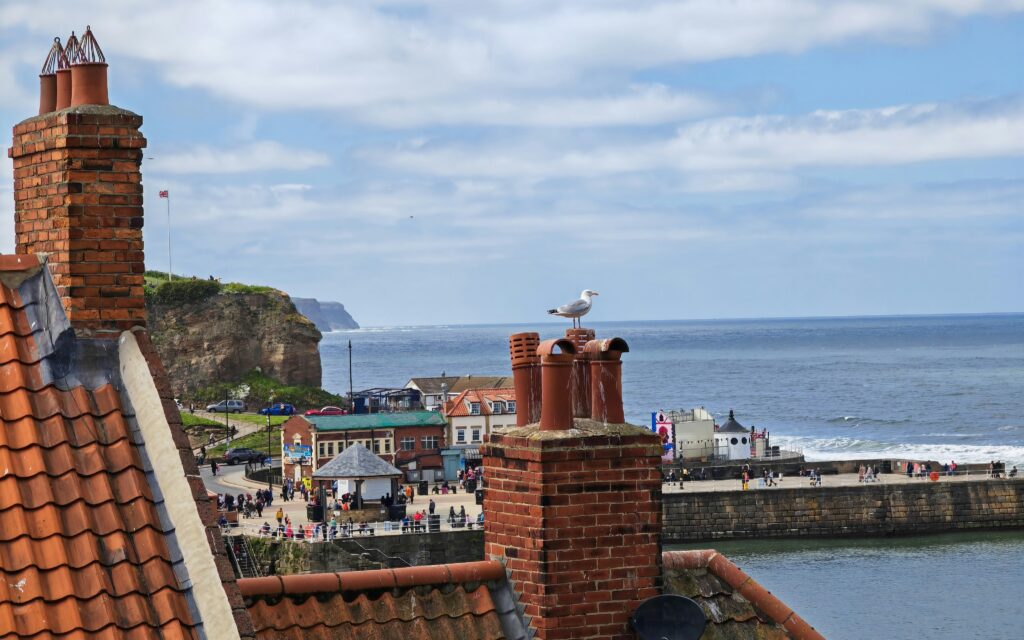
Problems affecting the chimney stack itself, such as cracked or leaning brickwork, missing or damaged pots, deteriorating flaunching (the mortar that seals pots into the stack), as well as loose, cracked or missing tiles along the ridge line at the top of the roof.
What causes it
Chimneys are among the most exposed parts of any roof, taking the brunt of wind, rain and frost. Mortar joints erode over time, especially where a chimney is no longer in regular use and hasn’t been maintained. Ridge tiles are mortar-bedded in place and can work loose as that bedding ages and cracks, particularly after a period of strong winds.
How to spot it
A stack that looks visibly out of line, has cracked or crumbling pointing, missing pots, and an uneven or gappy ridge line are the main things to look for from ground level. Given the height involved, though, a proper close-up look usually needs more than the naked eye.
Where a survey adds value
Chimneys are difficult and often unsafe to inspect closely without scaffolding, which is precisely where drone imagery earns its keep. A survey can tell you whether you’re looking at a straightforward repointing job or something more urgent, such as a leaning stack that needs prompt attention.
Roof sagging and roof spread
What it means
A visible dip, bulge or unevenness along the roofline, or “roof spread”, where the rafters gradually push the walls they sit on outward over time.
What causes it
This is usually about the roof’s own structure rather than the ground beneath the house. Common causes include undersized or ageing timbers, historic alterations that removed load-bearing support, or roof coverings that have been added without checking the structure could carry the extra weight. As mentioned earlier, ground movement is a less likely explanation than many buyers assume – a flexible, pitched, tiled roof tends to move with a building rather than crack or visibly sag because of it.
How to spot it
Stand back and look along the ridge from the street: it should run in a straight line. A noticeable dip, wave or bulge between rafters is worth investigating, as is any bowing in ceilings on the top floor.
Where a survey adds value
Distinguishing between a roof that’s cosmetically uneven – often the case in older or altered properties – and one with a genuine structural problem takes trained judgement. A survey will assess whether any movement is historic and stable or ongoing and will only recommend further investigation by a structural engineer where it’s actually warranted, rather than as a default response.
Rotten or decaying roof timbers
What it means
Decay that affects the timber structure of the roof – rafters, purlins, ridge boards or joists – usually caused by prolonged exposure to moisture.
What causes it
Persistent damp is almost always the underlying cause, whether from a long-standing leak, condensation caused by poor loft ventilation, or historic woodworm activity that’s created a weak point. Timber decay in Sussex roofs is more often historic than active; evidence of a problem that occurred years ago and has since been resolved.
How to spot it
This is one of the hardest defects to identify without going into the loft, since it’s rarely visible from inside the living space. Signs include soft or spongy timber, dark staining, a musty smell, and in more serious cases, visible fungal growth.
Where a survey adds value
Knowing the difference between old, treated evidence of decay and an active, ongoing problem is exactly the kind of judgement a survey provides. It spares you either false reassurance or unnecessary alarm. Where real concern exists, a surveyor can advise on next steps, from improving ventilation to targeted repairs or, in rarer cases, more extensive treatment

Flat roof defects
What it means
Problems specific to flat roofs – typically felt, EPDM rubber, GRP fibreglass or asphalt – commonly found on extensions, garages, dormers, and some Sussex properties built or extended between the 1930s and 1960s.
What causes it
Flat roof coverings generally have a shorter service life than pitched, tiled roofs, and age is the most common underlying cause of problems. Ponding, where water sits on the surface rather than draining away, points to inadequate falls (the slight slope a flat roof needs) and can accelerate deterioration. Blistering, cracking and splitting at joints or upstands typically follow as the membrane ages or moisture becomes trapped underneath.
How to spot it
The main indicators are standing water more than 48 hours after rain, visible cracking, bubbling or blistering on the surface, and damp patches on the ceiling directly below. Flat roofs tend to give fewer early warning signs than pitched roofs, so problems can go unnoticed for longer.
Where a survey adds value
Because flat roofs are considered a limited-life element of a property, a survey can help establish roughly how much useful life is left, whether repair is realistic or a full replacement makes more sense, and how urgently any action is needed. This can be particularly useful when buying a property with an older extension.
It’s this kind of clear, independent reporting that comes through in Tate’s Google reviews. As one recent client put it:
[Quote] The service was prompt, comprehensive and called out all the areas of concern to enable me to make the decision as to whether to proceed with my purchase. — Rob Jones
Book a roof survey
If any of this sounds familiar, or you’d simply like an independent, up-to-date picture of your roof’s condition, a roof survey from Tate Surveying Services gives you a clear, professional assessment without the guesswork. We cover Sussex and the South East, and use drone technology to inspect roofs closely without the time and cost of scaffolding. Book a roof survey to find out more, or get in touch to discuss your property.
Your roof questions answered
Do roof defects always mean I need a new roof?
No. In the vast majority of cases, roof defects reported in a survey are minor, historic or straightforward to put right, rather than a sign the whole roof needs replacing. A pitched, tiled roof in reasonably good overall condition can often be repaired element by element for many years before a full replacement is needed.
Can subsidence cause cracks in my roof?
It’s rare. Sussex has plenty of clay soil and mature trees, both associated with subsidence, so it’s a fair question to ask. But as our lead surveyor Marc Tate points out, most Sussex roofs are pitched and covered in tiles or slates, which are naturally flexible – unlike a rigid masonry wall, a tiled roof can move slightly without cracking. Where ground movement genuinely is a factor, it’s far more likely to show up as cracking in the walls below than in the roof itself. If you’re concerned about subsidence, this is exactly the kind of thing a survey helps put into context.
How much do roof defects typically cost to fix?
It depends enormously on the defect, the roof type and how easy the roof is to access, so treat any figure as a starting point rather than a quote. Costs can vary significantly by contractor, property and access and we’d always recommend getting a written quote for your specific situation rather than relying on any general figure.
Will my buildings insurance cover roof damage?
It depends on your policy and the cause of the damage. Storm damage is often covered, whereas gradual wear and tear generally isn’t. We’re not insurance advisers, so it’s always worth checking your policy documents or speaking to your insurer directly. If you do need an independent survey report to support a claim, our Building Insurance Claims Assistance service is designed for exactly that.
How often should I have my roof inspected?
There’s no single official rule that applies to every property, so treat this as general good practice rather than a hard deadline. Many homeowners find it useful to take a look (or have a professional take a look) after any significant storm, roughly every few years as routine maintenance, and always before undertaking major works such as a loft conversion or extension. Older properties, or those that haven’t been looked at in some time, tend to benefit most from a proper inspection.
What’s the difference between a drone roof survey and someone going up on a ladder?
A ladder only gives access to the roof edge. Scaffolding, while thorough, adds significant time and cost before any repair work has even been scoped. A drone fitted with a high-resolution camera can inspect the entire roof surface, including chimneys, valleys and rear slopes that would otherwise be impossible to see safely, without the disruption or expense of scaffolding. Find out more on our roof surveys page.
My HomeBuyers Survey mentioned a roofing concern. Do I need a separate roof survey?
Not always, but it depends on what was flagged. A RICS Level 2 HomeBuyers Survey or Level 3 Full Building Survey will identify visible roofing defects, but neither includes a detailed, close-up inspection of the whole roof surface. If your surveyor has recommended further investigation, or the roof hasn’t been properly looked at in some years, a dedicated roof survey – with drone imagery where useful – will give you a much clearer picture of what needs doing and how urgently.


