
Party wall pitfalls that can delay your build (and how to avoid them)
If you’re planning a loft conversion, rear extension or basement project, congratulations! Exciting times lie ahead! It’s natural that you’ll be focused on builders, drawings and budgets. But there’s something else that regularly delays home renovation projects – and it’s often overlooked until it’s too late.
Party wall issues.
Many homeowners automatically search for “party wall surveys” believing the next step is to have a specialist physically inspect the wall. This is rarely necessary or useful – there may not be a physical wall involved! What does matter is complying with the Party Wall etc. Act 1996 – a legal process with clear steps and mandatory timescales. If you start the process too late, your build can be pushed back by weeks or even months.
At Tate Surveyors, we help homeowners avoid these delays by providing fast, accurate and easy-to-understand Party Wall Notices and Awards. Here we’ve outlined the most common pitfalls and how to sidestep them with plenty of time to spare.

The no.1 misunderstanding: “Do I need a party wall survey?”
Short answer: not usually.
A “party wall surveyor” is a legal appointment under the Act. Their focus isn’t inspecting a wall’s structure, but managing the notices, the Schedule of Condition and the Party Wall Award so work can go ahead safely and lawfully.
The purpose isn’t to diagnose defects in a wall. Instead, it’s to ensure that the works you’re planning are carried out lawfully, safely and with proper protection for your neighbour.
The Act focuses on:
- Serving valid notices
- Agreeing a Party Wall Award
- Recording a Schedule of Condition of the neighbour’s property
- Setting out how and when works can proceed
What matters is the process, not inspecting the bricks and mortar.
Why the party wall process causes delays
The party wall process follows a set legal timetable. This simple timeline shows why starting early is essential if you want your build to begin on schedule.
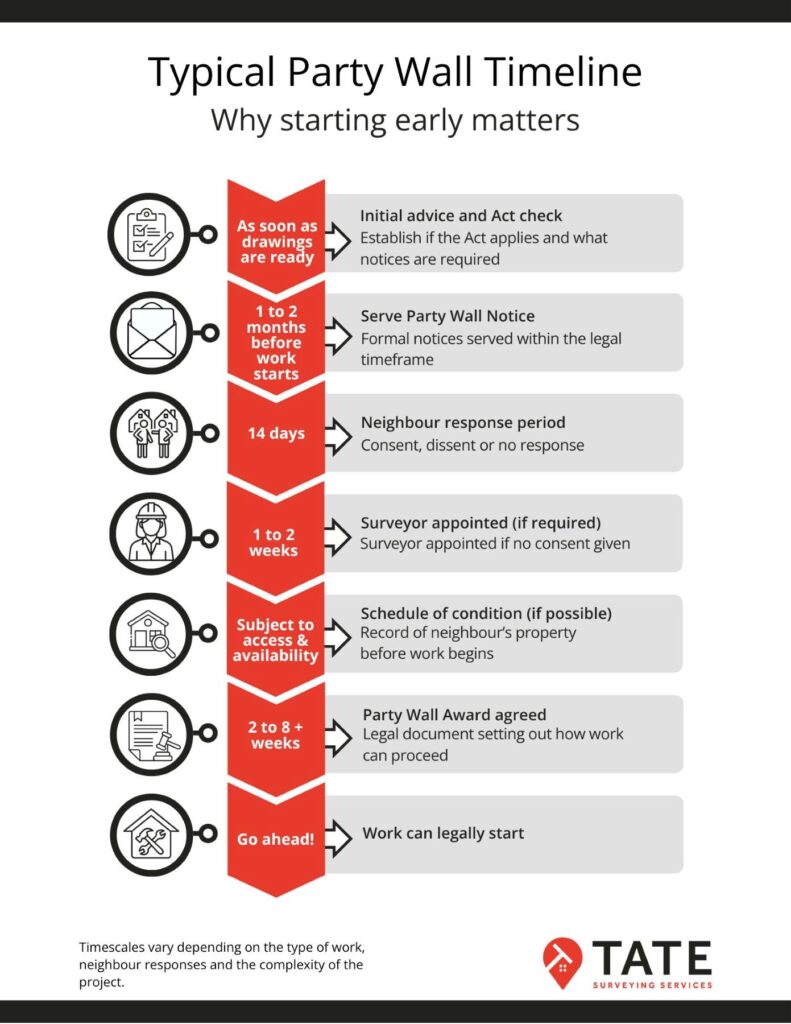
Download a copy of this timeline
Even straightforward projects can take several weeks to progress through the party wall process. Starting early helps avoid last-minute delays, redesigns and unexpected costs.
The Act has strict timeframes that can’t be skipped, even if your contractor is ready to start.
Here’s how delays commonly occur.
1. Not checking whether the Act applies
Many homeowners only discover they need to serve notices once their architect or contractor raises it during the final planning stages. By that point, the intended start date may be just around the corner – but the legal clock hasn’t even started.
The Act applies to a surprisingly wide range of works: extensions, removing chimney breasts, loft conversions involving steels, excavations near neighbouring foundations, or anything built up to (or astride) the boundary. Missing this first step often sets off a chain reaction that slows everything else down.
2. Serving notices too late (or incorrectly)
Notices must be served well in advance – one or two months ahead depending on the nature of the works. Problems arise when homeowners rely on downloaded templates, include incomplete information, or send informal messages instead of proper legal notices.
If a notice turns out to be invalid, it must be reissued, and the time period begins again from day one. This alone can push projects back several weeks.
3. Waiting for neighbour responses
Once notices are served, neighbours have 14 days to respond. If they don’t reply, the law automatically treats the silence as dissent, meaning surveyors must be appointed on both sides.
This stage frequently causes delays. Some neighbours forget to reply; others want to see more detailed plans; and some simply feel nervous about the potential impact of the works. Even when relationships are friendly, responses aren’t always quick – and the project can’t progress until the legal time period has run its course.
4. Scheduling the Schedule of Condition
This is not a “survey of the wall” – it’s a record of the neighbour’s property before work begins. It protects both parties by documenting the condition of walls, ceilings and finishes that could be affected by the works.
A Schedule of Condition is strongly advisable and considered best practice, but it relies on neighbour access and cooperation.
Where possible, surveyors will record a Schedule of Condition before work begins – but the absence of access does not prevent a Party Wall Award being agreed.
Delays commonly occur when neighbours are away or unavailable, when surveyors are booked up during busy periods, or when access simply can’t be agreed.
Where access is possible, surveyors will always aim to complete a Schedule of Condition, as it protects the neighbour from genuine damage and protects the building owner from unfounded claims later on.
However, if a neighbour does not engage at all and access can’t be obtained, the party wall process can still move forward. In these cases, a surveyor can be appointed on the neighbour’s behalf and a Party Wall Award can be agreed without a Schedule of Condition, allowing works to proceed lawfully.
5. Agreeing the Party Wall Award
The Award is the legal document that allows the work to start. It outlines how the works must be carried out, what protections are needed, how access will be managed and how any damage will be handled.
Awards take time to prepare because both surveyors must be satisfied that the proposed works are safe, clear and properly documented. Missing drawings, unclear engineering details, unusual or complex methods of excavation and disagreements between surveyors all add to the timeline. Work cannot legally begin until the Award is signed.
(Photo by Marina Yalanska on Unsplash)
Why starting early protects your budget and your timeline
Most project delays occur simply because the party wall process was started too late.
Beginning early gives everyone space to work efficiently. Neighbours have time to ask questions and feel comfortable. Surveyors can review drawings without pressure. Any engineering changes can be addressed before builders are booked or deposits are paid. And crucially, it reduces the risk of rethinking your design after spending money on plans.
The earlier you begin, the smoother – and more predictable – your build will be.
What homeowners often get wrong
Here are the pitfalls we see most often:
- Assuming a friendly neighbour will consent immediately. Delays happen even in the friendliest streets.
- Thinking a survey of the wall is required. It isn’t – but the legal process is.
- Leaving notices until after planning permission. They should run in parallel.
- Setting start dates before the Award is complete. This is risky and is one of the biggest causes of stress and extra cost.
- Underestimating the time needed for neighbours to respond. The legal clock runs slowly – and cannot be sped up.
Each of these can be avoided with earlier planning and specialist guidance.
How to avoid party wall delays
The best way to protect your project is to start the party wall process early – ideally 2–3 months before work is due to begin.
That means:
- Preparing professionally drafted notices
- Speaking to neighbours early and openly
- Providing surveyors with clear drawings and engineering details
- Avoiding large contractor deposits until the Award is finalised
- Using experienced party wall surveyors who keep things moving and minimise disruption
Tate Surveyors handle all the legal and administrative steps on your behalf. We guide you – and your neighbour – through the process calmly and clearly, reducing delays and helping your project progress as smoothly as possible.
For many homeowners, party wall issues are rarely at the top of their minds when planning a renovation – yet they’re often the first thing to slow a project down. The good news is that almost all of these delays are avoidable with early preparation and expert support.
If you’re planning building work and aren’t sure whether the Party Wall etc. Act applies, we can help.
Contact Tate Surveyors for fast, accurate and easy-to-understand Party Wall Notices and Awards, and keep your project moving on schedule.